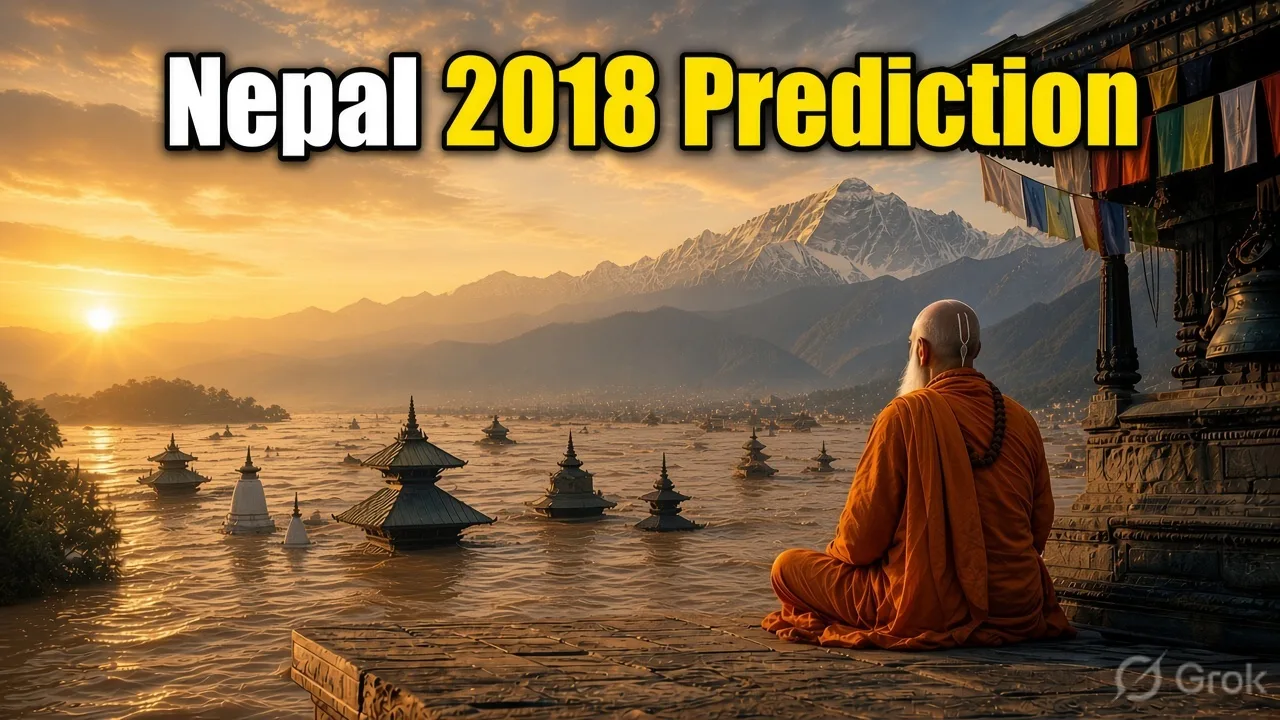
The phrase “2018 Nepal prediction Puri Shri Shankaracharya” refers to a statement attributed to Puri Shankaracharya Swami Nischalananda Saraswati at a religious gathering in Kathmandu. According to a 2025 report by United News of India, he said: “A revolution will arise from Nepal, and India along with the world will learn from it.” [1]
The statement has since been recirculated online alongside discussions about protests, Nepal’s political frustrations, the monarchy debate, and demands for a Hindu state. However, the available evidence supports a careful conclusion: the quotation is reported by a news agency, but its connection to any later event is an interpretation, not a demonstrated fact. No contemporaneous transcript or primary recording was independently verified for this article.
| Question | What the available evidence shows | Confidence |
|---|---|---|
| Who made the statement? | UNI attributes it to Puri Shankaracharya Swami Nischalananda Saraswati. | Reported |
| When and where? | A religious gathering in Kathmandu in 2018. | Reported by UNI |
| What is the reported wording? | “A revolution will arise from Nepal, and India along with the world will learn from it.” | Reported quotation |
| What does Nepal’s Constitution say? | Nepal is a secular federal democratic republic, with sovereignty vested in the Nepali people. | Constitutional text |
| Does later unrest prove the prediction? | No. Political developments may motivate retrospective interpretations, but they do not independently verify a prophecy. | Not established |
What the 2018 Nepal prediction reportedly said
The core claim is brief. UNI reported that, during a Kathmandu religious gathering in 2018, Shankaracharya said a revolution would arise from Nepal and that India and the world would learn from it. The same report said the words later resurfaced on social media amid renewed attention to Nepal’s political situation. [1]
The quotation should therefore be described as a reported statement, not as a fully authenticated transcript. Social-media videos and captions often add stronger claims, such as a guaranteed restoration of a Hindu kingdom or a specific political timetable. Those additions should not be treated as part of the original quotation unless a primary source confirms them.
Who is Puri Shri Shankaracharya?
Swami Nischalananda Saraswati is identified by the official Govardhan Peeth website as the current Shankaracharya of Puri Peeth. The institutional biography says he was born on 30 June 1943 in Madhubani district, Bihar, studied Vedic and philosophical texts, and was appointed the 145th Shankaracharya of the Govardhana Peetha at Puri. [2]
This background explains why the statement carries religious significance for followers. It does not, by itself, establish that every political forecast attributed to him is historically accurate. The speaker’s authority within a religious tradition and the evidentiary status of a particular quotation are separate questions.
Why did the prediction resurface?
Older statements often return to public attention when current events appear to resemble their language. In this case, reporting in 2025 described renewed calls in Nepal for the restoration of the monarchy and the return of a Hindu state. New Lines Magazine linked the debate to dissatisfaction with political corruption, distrust of political elites, and a crisis of political legitimacy. [3]
That context can make the word “revolution” appear newly relevant to readers. Yet resemblance is not proof of prediction. A statement about a possible future can be broad enough to receive multiple interpretations after events occur, particularly when it has been reposted with edited captions or without its original context.
Nepal’s constitutional position
Nepal’s constitutional framework is essential context. Article 4 of the Constitution describes the country as an independent, sovereign, secular, inclusive, federal democratic republican state. It also states that sovereignty and state authority are vested in the Nepali people. [4]
This means that claims about Nepal becoming a Hindu state or restoring its monarchy would involve major political and constitutional changes. Such changes cannot be inferred from a religious statement alone. They would require verifiable political action, legal processes, public decisions, or constitutional amendments.
Is the 2018 prediction coming true?
There is no objective test that can prove a broad religious prediction has been fulfilled merely because later events share a theme with it. Nepal has experienced political debate and protest, and some groups have called for changes to the country’s republican and secular model. Those facts may explain why the quotation is being discussed, but they do not prove that the 2018 statement predicted a particular protest, government, election result, or constitutional change.
A more accurate description is that later political developments have prompted people to reinterpret the statement. Supporters may see the developments as a meaningful confirmation. Skeptics may see the statement as general enough to fit several possible outcomes. A fact-checked article should report both the quotation and the limits of what can be established.
What can be verified and what cannot?
The following distinction helps separate evidence from online commentary:
| Claim | Evidence-based assessment |
|---|---|
| A statement was attributed to Puri Shankaracharya in connection with a 2018 Kathmandu gathering. | Supported by UNI’s 2025 report. [1] |
| The reported statement referred to a revolution arising from Nepal. | Supported by the quotation published by UNI. [1] |
| The statement specifically predicted a return to monarchy. | Not established by the reported quotation. |
| The statement specifically predicted Nepal becoming a Hindu state. | Not established by the reported quotation. |
| Later protests prove the prediction was supernatural or exact. | Not verifiable as a historical fact. |
| Nepal’s current constitutional identity is secular and republican. | Supported by the constitutional text. [4] |
The strongest version of the claim should always be checked against the original speech. Researchers should look for a complete recording, a contemporaneous transcript, the event date, the full surrounding passage, and an unedited translation if the speech was delivered in another language.
A short timeline
2018: UNI reports that the statement was made during a religious gathering in Kathmandu. [1]
2007 and 2015 constitutional context: Nepal’s transition to a secular state and later constitutional description as a federal democratic republic form the legal background against which any Hindu-state or monarchy debate must be understood. [4]
2025: Reports describe the resurfacing of the statement while Nepal faced renewed debate over monarchy and a Hindu-state model. [1] [3]
Today: Online posts continue to present the statement in different forms. Readers should distinguish the original reported wording from later captions, commentary, and predictions added by social-media users.
Final assessment
The 2018 Nepal prediction attributed to Puri Shri Shankaracharya is best understood as a reported religious and political statement that has acquired new attention. The available report gives a concise quotation about a revolution arising from Nepal, but it does not establish a specific forecast about monarchy, Hindu nationalism, or a particular future event.
The responsible conclusion is neither to dismiss the religious importance of the statement nor to present later political developments as proof that a prophecy has been fulfilled. The evidence supports the quotation’s reported existence, while the larger claims circulating online remain interpretations that require separate verification.
Frequently Asked Questions
What did Puri Shankaracharya predict about Nepal in 2018?
UNI reported that he said, “A revolution will arise from Nepal, and India along with the world will learn from it.” The available report does not, by itself, establish a specific prediction about a restored monarchy, a Hindu state, or a particular date. [1]
Who is Puri Shri Shankaracharya Swami Nischalananda Saraswati?
He is identified by the official Govardhan Peeth website as the current Shankaracharya of Puri Peeth and the 145th Shankaracharya of the Govardhana Peetha at Puri. The site also provides biographical information about his education and religious training. [2]
Did Puri Shankaracharya predict that Nepal would become a Hindu state?
The quotation reported by UNI refers to a revolution arising from Nepal, but it does not explicitly say that Nepal would become a Hindu state. Social-media posts may interpret it that way, but that interpretation should not be presented as the confirmed wording of the 2018 statement.
Why is the 2018 Nepal prediction trending again?
The statement resurfaced amid renewed public debate about Nepal’s monarchy, secularism, and political dissatisfaction. Reporting has connected that debate to frustration with corruption and distrust of established political parties, but current events do not independently prove that the statement was a precise forecast. [1] [3]
Is the 2018 Nepal prediction proven to have come true?
No. The statement is broad, and later political events can be interpreted in different ways. A claim that it came true would require a clearly defined prediction, a verified original source, and an objective match between the forecast and a specific event.
SEO strategy
This article targets the primary keyword “2018 Nepal prediction Puri Shri Shankaracharya” and related searches such as “Puri Shankaracharya Nepal prediction,” “Swami Nischalananda Saraswati 2018 statement,” “Nepal revolution prophecy,” and “Nepal Hindu state prediction.” It uses a direct answer near the top, a verification table, contextual headings, a timeline, a distinction between reported evidence and interpretation, and five question-style FAQs designed for answer-engine visibility.
Suggested title tag:
2018 Nepal Prediction by Puri Shankaracharya: Fact Check
Suggested meta description:
What did Puri Shankaracharya reportedly say about Nepal in 2018? Read the verified quotation, constitutional context, later interpretations, and fact-check.