**15 flights diverted as heavy rain, thunderstorms lash Delhi-NCR; traffic snarls, waterlogging reported – The Times of India**
**Delhi-NCR Under Siege: 15 Flights Diverted, City Paralysed as Monsoon Rages**
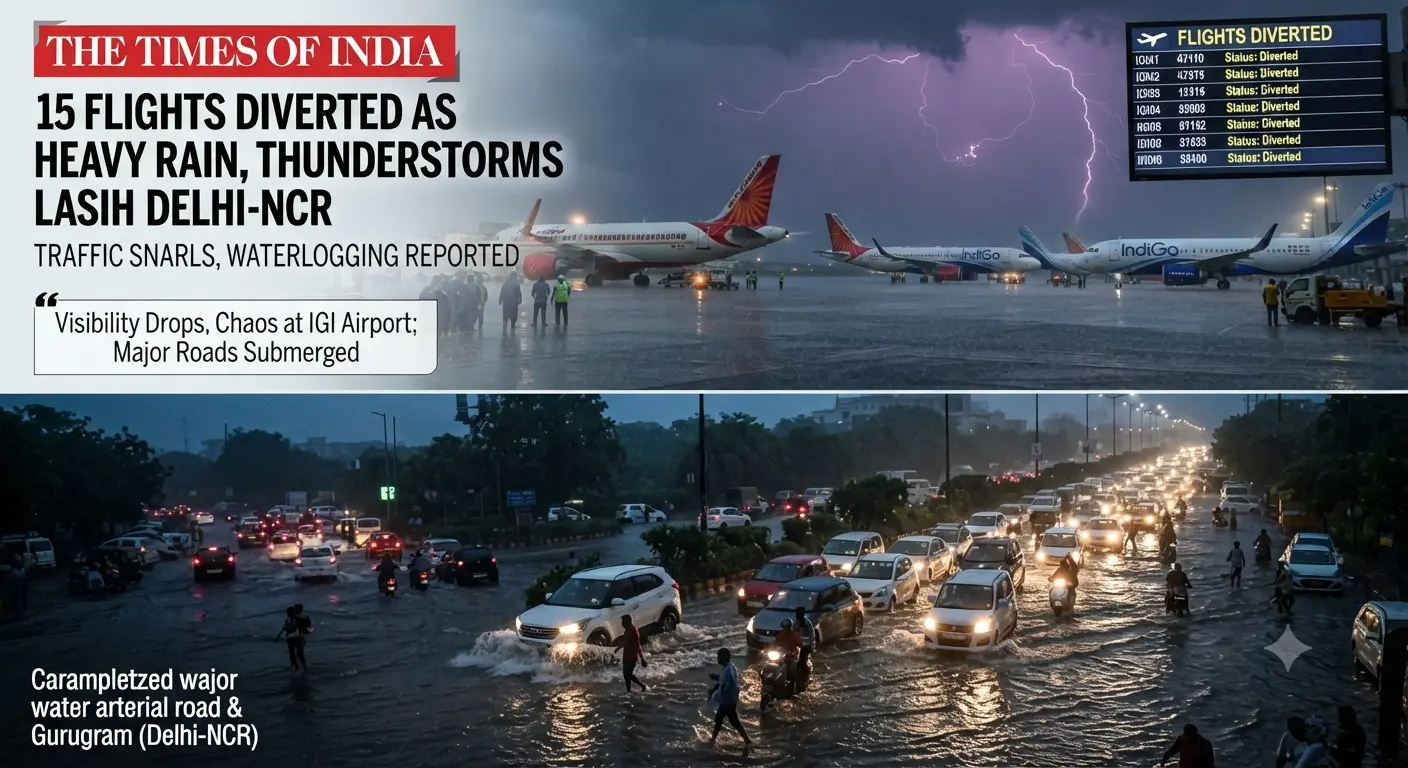
Delhi-NCR woke up to a chaotic Monday morning as relentless heavy rain and violent thunderstorms battered the region, bringing daily life to a near-halt, disrupting air travel, and pushing civic infrastructure to the brink. With the India Meteorological Department (IMD) issuing a yellow alert and predicting continued precipitation over the next 48 hours, the region witnessed 15 domestic flights being diverted to nearby airports, massive traffic jams stretching across key arterial roads, and widespread waterlogging that turned several underpasses and stretches into temporary lakes. The sudden turn of weather, described by experts as an early-onset monsoon surge triggered by a western disturbance interacting with moist easterly winds, has once again exposed the fragile preparedness of India’s capital and its satellite towns.
The Indira Gandhi International Airport (IGI) became the epicentre of travel chaos. According to official statements from the Airports Authority of India (AAI) and major carriers like IndiGo, SpiceJet, and Air India, at least 15 flights—both arrivals and departures—were redirected to alternative airports including Jaipur, Lucknow, and Chandigarh between early morning and mid-day. The diversions were necessitated by poor visibility, water accumulation on runways, and thunderstorm activity that made landing conditions unsafe. Passengers aboard affected flights took to social media to share videos of rain-soaked cabins, anxious waiting lounges, and last-minute announcements. IndiGo, in a statement, apologised for the inconvenience and said it was rebooking passengers on the next available flights, while SpiceJet announced hotel vouchers for those stranded beyond six hours. Air India coordinated with the Directorate General of Civil Aviation (DGCA) to ensure minimal disruption to connecting journeys. The airport’s operational team worked round the clock to clear debris, pump out accumulated water, and restore normal landing schedules by the evening, though several inbound flights continued to face delays well past sunset.
Meanwhile, the road network across Delhi-NCR turned into a nightmare for commuters. The Delhi Traffic Police issued multiple advisories, urging residents to avoid non-essential travel and use metro services wherever possible. Key stretches such as the Mathura Road, NH-24, the Delhi-Noida Direct (DND) Flyway, and the Ghaziabad-Faridabad corridor witnessed gridlocks lasting over two hours. Several underpasses, including the ones at ITO, Rajghat, Vikas Marg, and the AIIMS underpass, were waterlogged up to three feet, stranding vehicles and forcing commuters to wade through knee-deep water. The Municipal Corporation of Delhi (MCD) and the Public Works Department (PWD) deployed over 200 pumps and a fleet of tractors to clear stagnant water, but the sheer intensity of rainfall—recorded at 52 mm at Safdarjung Observatory in just three hours, against the monthly average for June—overwhelmed drainage systems that were already clogged with silt and debris from pre-monsoon cleaning drives that were reportedly incomplete due to staff shortages.
The thunderstorms also brought with them uprooted trees, snapped electricity poles, and intermittent power outages in several colonies across South and West Delhi. Residents of areas like Malviya Nagar, Vasant Kunj, Dwarka, and Gurugram reported power cuts lasting anywhere from 30 minutes to over two hours. The Delhi Disaster Management Authority (DDMA) activated its control room and urged citizens to stay indoors, keep emergency kits ready, and report any life-threatening situations via the 1077 helpline. In Gurugram, the municipal body reported waterlogging on the Sohna Road and Golf Course Road, with several commercial complexes reporting water seepage into basements. Noida and Greater Noida also witnessed traffic snarls on the Yamuna Expressway and the Knowledge Park corridors, though the situation was relatively better managed compared to the national capital side.
Environmental experts and weather analysts pointed to a combination of factors for the severity of the event. The IMD had, in its extended forecast for June, warned of an early and active monsoon phase for Northwest India, driven by a strong positive Indian Ocean Dipole (IOD) and anomalous heating over the Thar Desert. This year, the monsoon’s advance over Kerala was recorded on May 30—seven days ahead of schedule—and has since been pushing rapidly northward. The current spell over Delhi-NCR is attributed to the interaction of the monsoon trough with a cyclonic circulation over Punjab and a trough over Uttar Pradesh, resulting in enhanced moisture convergence and intense convective activity. Climate scientists have increasingly linked such extreme early-season weather events to rising global temperatures, altered jet stream patterns, and the urban heat island effect that makes cities like Delhi more susceptible to flash flooding and heat-storm hybrids.
Civic bodies came under scrutiny for the state of preparedness. Activists from non-governmental organisations focusing on urban governance highlighted that desilting of drains, cleaning of stormwater drains, and repair of leaking sewage lines—routine pre-monsoon tasks—had been delayed due to the prolonged general election model code of conduct and administrative reshuffles. The MCD admitted in a press briefing that while 70% of the city’s major drains had been desilted, the remaining 30%, particularly in low-lying and unauthorised colony areas, remained vulnerable. The PWD stated that 15 critical underpasses had been fitted with temporary pumping mechanisms, but acknowledged that the volume of rainfall exceeded designed capacity in several zones. Residents, meanwhile, took to social media to share geotagged photos and videos of waterlogged streets, tagging elected representatives and demanding immediate relief measures.
Airlines and travel agencies worked overtime to manage the fallout. Besides the 15 diverted flights, over 30 flights experienced delays ranging from 45 minutes to three hours. Travel portals reported a spike in last-minute hotel bookings near the airport and in satellite towns, with prices of budget accommodations in Gurgaon and Noida jumping by up to 40%. The DGCA issued a circular advising airlines to factor in additional turn-around time and ensure runway surface conditions are thoroughly checked before operations. Passengers were advised to check their flight status regularly, carry essential items in carry-on luggage, and utilise the airlines’ rebooking policies without penalty. Several corporate offices in Noida and Gurugram allowed work-from-home for the day, citing safety concerns and waterlogging near their campuses.
As the day progressed, the rain began to ease in the late afternoon, but the aftermath lingered. Water continued to drain slowly from low-lying areas, and several roads remained slippery. The IMD forecasted that the monsoon trough would remain active, with light to moderate rain likely to continue on Tuesday and Wednesday, though the intensity is expected to decrease. The yellow alert has been extended, and authorities have urged citizens to remain cautious, especially during evening commutes when visibility may further drop. Schools in some districts announced a half-day or online classes, while offices in the central government’s secretariat complex in Delhi issued internal advisories for staff to avoid travel unless absolutely necessary.
The event has reignited the debate on urban resilience and climate adaptation in India’s megacities. Experts argue that beyond emergency responses, long-term infrastructure upgrades are imperative. This includes expanding the capacity of stormwater drainage networks, implementing “sponge city” concepts that promote rainwater harvesting and permeable surfaces, and enforcing stricter building codes that prevent construction in flood-prone zones. The Delhi government’s ambitious “Yamuna Rejuvenation” project and the Haryana government’s “Green Gurgaon” initiative were cited as steps in the right direction, but analysts stressed that implementation speed and community participation remain key gaps. Moreover, the integration of real-time weather data with traffic management systems and airport operations was highlighted as a critical area for digital transformation.
For the average commuter, the day served as a stark reminder of how quickly normalcy can be upended by nature’s fury. Many shared stories of being stuck in traffic for over three hours, of children wading through water to reach home, and of the solidarity displayed by neighbours who helped each other pump out water and provide shelter. As the sun set over a glistening, rain-washed Delhi-NCR, the city slowly began to limp back to routine, but the memory of Monday’s deluge will likely influence how residents, officials, and planners prepare for the monsoon season ahead. The incident underscores the urgent need for a coordinated, science-driven approach to urban flooding, one that balances development aspirations with the reality of a changing climate, and ensures that the next thunderstorm doesn’t bring the capital to its knees.
**Key Highlights:**
– 15 domestic flights diverted from IGI Airport to Jaipur, Lucknow, Chandigarh
– Over 52 mm rainfall in three hours at Safdarjung—exceeding June monthly average
– Major underpasses waterlogged: ITO, Rajghat, Vikas Marg, AIIMS
– Traffic jams on NH-24, DND, Mathura Road, Noida-Ghaziabad corridor
– Power outages in South, West Delhi and Gurugram; trees uprooted across NCR
– IMD yellow alert active; light to moderate rain expected to continue
– MCD, PWD deployed 200+ pumps; desilting status at 70% for major drains
– Airlines offered rebooking, hotel vouchers; DGCA issued operational circular
– Climate link: early monsoon surge, western disturbance interaction, urban heat island effect
– Calls for long-term drainage upgrades, sponge city models, real-time weather integration
🔗 Read the full original news here: https://news.google.com/rss/articles/CBMi4wFBVV95cUxPNElFY1F2M0pSN0dteXVRWjZwNjVpVU5OLUZ3eXNUQ3VDTXVOWkV4eDJzampSRnF0YXBVLUhUSUZuZlM2OEExVXhNRG45b0NMTENoZmY5eXNTblB0Zm9STFpIb2NGSFIyd2ZQSWlhQlBUa1lxUFZmemtPemVZMGlWTHpEcHB0ZzlkaTVFSnFMYnFWc0VBOFNWZENiV0prY0NCNlBTUFhLbEhGLVhlXzNfY3Z2amdXRlBleEYzVlljSmk2TWtydUtUaTlLS2JFS3llOGhna2FqZkZfd0ttRlc1TjJ5VdIB6AFBVV95cUxPYjRvRnpVV0NqUnN5VXpqOWVzV3NTalhsbFhOR25wZnQtT1Yxc2laS3d0SFRRZGdKbkhaNGZmTmFFc0ZzSnVad2pLSk1hMnJidzZmYlNVVWtVRjlDWjk1ajktaDRZbXB1d3VJdEZCSUZxb0RFRkdfcDZxRWRpVmMzLWo0SnAtUTVWQ2tnQmpFZ2ROSXFiWVJ2UWFTbFdoalk2X0hiNFpMbldZZTNVMTROcUhINWpFVzF0dnc4Z0RoTGpUVi1yQ051TzNZeUtiMnVPcnFmWVZGYlFRMkl4X1lvYkI3ZzQ4VUdM?oc=5